
International brewers are investing in soft drinks, pharmaceuticals, functional beverages and digital marketplaces. Yet beneath these new growth stories lies an uncomfortable economic question: do these businesses create enough value to justify the capital invested in them?
The price of promised growth
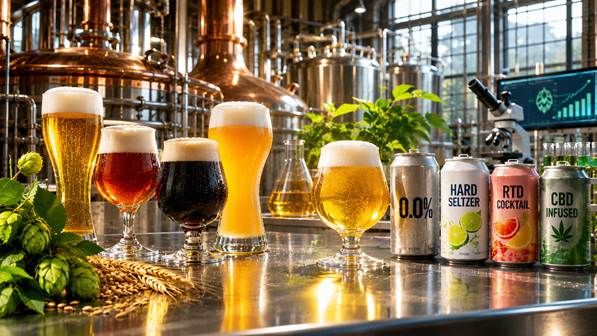
On 1 April 2026, Molson Coors paid $275 million for Atomic Brands, the US producer of Monaco Cocktails. The acquisition immediately put the group among the five largest suppliers of ready-to-drink cocktails in the United States. Monaco had an established brand, an extensive distribution network and a product that benefited from the growing interest in ready-to-drink beverages, or RTDs. For a brewer seeking to reduce its dependence on traditional beer, the deal looked like a logical move.
But the transaction raises a question that extends far beyond Molson Coors. What is a fast-growing brand really worth when so much of the expected growth has yet to materialise? A new beverage category can surge in a matter of years, prompting competitors to outbid one another with ever-higher acquisition prices. When that initial surge fades, the buyer may be left with a business whose sales are still rising but that cannot deliver the returns implied by its purchase price. Even a successful new product category can therefore become a poor investment.
That risk is not hypothetical. Roughly $200 million of Monaco’s purchase price was recognised as goodwill, largely reflecting expected future economic benefits. Meanwhile, Molson Coors’ worldwide brand volumes fell by almost 2.5 million hectolitres in the first nine months of 2026. The deal came just as Molson Coors was selling less beer and its profitability was coming under pressure.
It is a dilemma facing the entire international brewing industry. In mature markets, beer consumption is stagnating or declining, while brewing remains capital-intensive. Breweries require land, buildings, brewhouses, fermentation vessels, filling lines and warehouses. Those assets do not disappear when volumes fall. Fixed costs remain, spread across fewer hectolitres of beer. Premiumisation can help, but there are limits to consumers’ willingness to pay ever more per hectolitre.
International groups are therefore searching for new sources of revenue and profit. One buys soft-drink brands; another develops functional drinks or medicines. A third finds that its existing distribution network can also earn money from other companies’ products. Seven international groups demonstrate just how different the answers can be. The real measure is not how many activities they add, but how much economic value they create in doing so.
Carlsberg bets on a broader drinks business
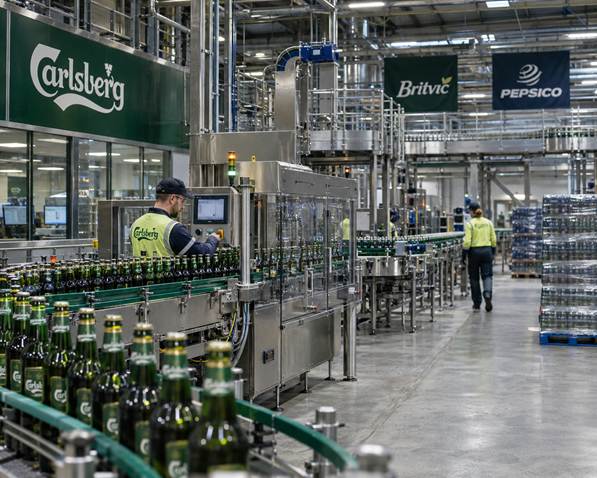
Carlsberg has arguably made the most visible change of direction in recent years. Its acquisition of Britvic in January 2025, at an enterprise value of approximately €4.8 billion, gave the Danish group a substantial soft-drinks portfolio and valuable bottling agreements. Soft-drink volumes increased from 24.5 million to 49 million hectolitres in 2025, almost entirely as a result of the acquisition. Yet reported return on invested capital fell from 13.8% to 10.1%, mainly because of the additional investment.
That does not mean Britvic was the wrong purchase. Carlsberg has decades of experience with soft drinks, water and PepsiCo products. The acquisition expands a business whose production, logistics and distribution can in part be combined with beer. But sound industrial logic does not guarantee an adequate financial return. Ultimately, the additional earnings must justify the price paid, the financing and the cost of integration.
The expansion of the PepsiCo partnership shows how Carlsberg intends to strengthen its position further. After more than 25 years as a PepsiCo bottler in Sweden and Norway, the group will also acquire the rights in Denmark, Finland and the three Baltic states from 1 January 2029. In Denmark and Finland, existing Coca-Cola agreements expire at the end of 2028. Carlsberg is also extending its PepsiCo activities in the Caucasus, including Azerbaijan, Georgia and Armenia.
This is about more than adding a few soft-drink brands. Carlsberg is building regional production and distribution clusters in which existing infrastructure can be used more intensively. A bottling line, warehouse or sales organisation serving several product categories can, at sufficient scale, be more profitable than a network devoted exclusively to beer.
At the same time, the group is looking to free up capital. Its proposed partnership with Sapporo would, on completion, bring in $643 million for a minority stake in existing Asian operations, while Carlsberg retains control. A potential stock-market listing of Carlsberg India fits the same approach. The group can unlock funds from established businesses without withdrawing altogether from attractive markets.
The company’s scientific heritage is also noteworthy. The Carlsberg Research Laboratory researches fermentation, yeast, grain breeding and hop genetics, among other areas. Through the Carlsberg Foundation, it supports basic research without an immediate commercial profit objective. That research is not a separate diversification business, but it can produce knowledge that later enables new products, ingredients and production processes.
Carlsberg is seeking to connect several elements: a broader drinks portfolio, more intensive use of production capacity, international bottling rights, scientific research and the release of capital. It is a coherent strategy. The risk lies in what it pays for growth. A well-utilised distribution network can create considerable value, but not if the acquisitions required to build it consistently prove too expensive.
Heineken grows in China without owning the breweries
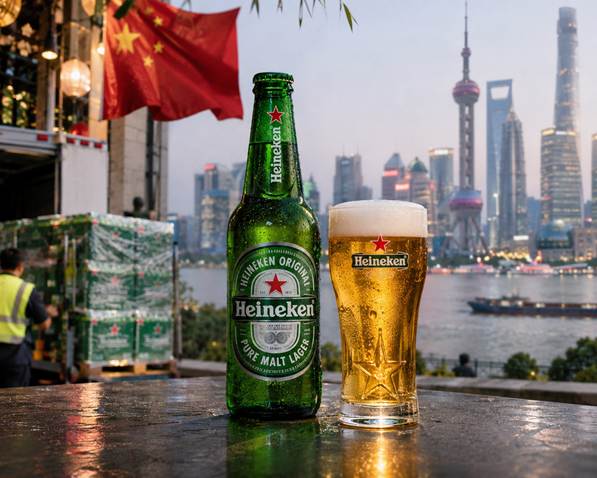
Heineken strikes a different balance between investment and partnership. This is particularly visible in China, where its cooperation with China Resources Beer has produced a model that ties up far less of Heineken’s own capital than building and operating a nationwide brewery network.
Heineken has a minority interest and a long-term partnership under which the Chinese partner produces and distributes the brand. This gives the Dutch group access to China’s vast beer market without having to own all the production facilities itself. The model exemplifies an asset-light strategy: its economic strength lies less in ownership of breweries than in brand value, licences and commercial agreements.
Yet an asset-light model is not a low-cost model. Heineken can earn an attractive return from its brand only while Chinese consumers remain willing to pay a premium for it. That position must be sustained through marketing, sponsorship, product development and consistent brand presentation. Part of the investment burden shifts from brewhouses and filling lines to building and defending the brand.
This is a fundamental distinction from the traditional capital model. A brewery operating its own production needs sufficient throughput to make its facilities pay. A company licensing its brand can grow with less production capacity of its own, but becomes more dependent on its partner and on the strength of the brand. If its premium position weakens, the attractive returns offered by licensing may come under pressure too.
Whether premiumisation alone can offset declining beer sales deserves a separate analysis. For the diversification debate, the important point is that Heineken has found a productive way to deploy existing brand value in a new market.
In Central America, however, the group has chosen greater direct control. The acquisition of significant FIFCO operations brought not only beer and soft-drink brands under Heineken, but also production, distribution and retail outlets. The parallel with former partner FEMSA, which developed the extensive OXXO retail network, is instructive. Moving closer to the consumer can give a company greater influence over presentation, availability and commercial information. The bargaining power of independent retailers does not disappear, but the company becomes less reliant on others within its own retail channels.
That market knowledge matters when Heineken evaluates new drinks brands. In Brazil, the group was already working with Better Drinks before an acquisition agreement was announced in November 2026. Its involvement with STËLZ in the Netherlands follows a similar pattern. Products are first sold through existing commercial relationships; only afterwards does the group decide whether increasing its ownership makes sense. Heineken can thus assess demand, distribution and commercial potential before committing more capital.
Heineken is also developing new beverage categories itself. Heineken 0.0, followed by 0.0 Ultimate, targets consumers seeking to avoid alcohol, sugar or calories. Outd0.0r Brewing, introduced in the United Kingdom in 2026, goes further: an alcohol-free isotonic lager containing, among other ingredients, electrolytes, magnesium and vitamin C. A traditional brewer is thereby moving towards functional beverages and new consumption occasions.
Heineken is therefore seeking not merely to sell different products but to remain relevant on more occasions throughout the day. The challenge is to turn those new occasions into genuinely incremental profit, rather than simply replace existing beer sales. The strength of the strategy is that many experiments can be pursued through existing brands and sales channels. The limitation is that small innovations only move the needle once they reach meaningful scale.
Japan’s brewers, two very different lessons
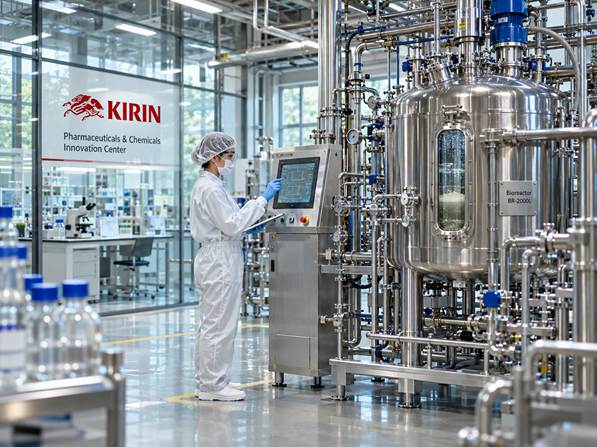
The development of Kirin and Asahi reveals a striking contrast. Both groups grew from the Japanese beer market into international businesses, but their experiences show that successful product development and successful overseas acquisitions require two very different sets of skills.
Kirin began pharmaceutical research as early as the 1980s. Its accumulated knowledge of microbiology and fermentation in brewing also proved useful in developing medicines. Over several decades, research, partnerships and acquisitions gave rise to a separate pharmaceutical business. In 2025, it generated ¥102.3 billion in normalised operating profit, approximately €605 million, accounting for more than 40% of consolidated normalised operating profit before central costs and eliminations.
Of the seven groups examined, this is the clearest example of diversification producing a substantial new profit stream. Kirin has not simply added another product category; it has built a fundamentally different line of business.
Its history of international acquisitions, however, tells a less successful story. Kirin invested heavily in Brazil’s Schincariol in 2011 and eventually sold its Brazilian brewing operations to Heineken in 2017. The overseas growth platform Kirin had hoped to build proved unsustainable. A group capable of successfully developing medicines is not necessarily equally capable of integrating and operating overseas brewing companies.
Kirin is now investing heavily in health products once again. Following Blackmores and FANCL, it announced in 2026 an acquisition of Canada’s Jamieson Wellness at an enterprise value of around C$2.5 billion. But its health-sciences operations are, for now, far less profitable than pharmaceuticals. The new acquisitions will have to demonstrate their returns on their own merits.
Asahi, by contrast, long pursued international growth primarily through beer. European brands made available by AB InBev’s acquisition of SABMiller, followed by Australia’s Carlton & United Breweries, gave the group a substantial overseas presence. At the same time, Asahi is developing products under the banner of Beer Adjacent Categories that can be rolled out through its international organisation. It is gradually becoming more than a brewer with an international footprint.
The proposed acquisition of Diageo’s stake in East African Breweries, however, represents a far bigger strategic gamble. Asahi intends to acquire 65% of EABL, whose operations include Kenya, Uganda and Tanzania. The transaction implies an enterprise value for EABL of approximately $4.8 billion, or roughly 17 times adjusted EBITDA on the published valuation.
That is a high price for access to an attractive growth region. Asahi would acquire strong local brands, distribution and businesses spanning beer, spirits and RTDs. Guinness and other Diageo brands would also remain important through long-term licences. But Asahi would also take on divergent economic conditions, regulatory regimes, distribution practices and operational risks.
The challenge is not simply that a Japanese company is managed differently from an African one. It is whether Asahi can combine financial discipline and its operating practices with local market knowledge and entrepreneurship without undermining EABL’s commercial strength. At that valuation, integration difficulties, disappointing volumes or political uncertainty could have substantial consequences.
Kirin and Asahi thus illustrate two sides of Japan’s international expansion. The former built a profitable new business through patient research but encountered difficulties with major overseas beer acquisitions. The latter acquired strong international brewing operations and is now taking a costly further step in East Africa. For both groups, capital discipline ultimately matters more than the appeal of the growth narrative.
AB InBev puts its customer network to work
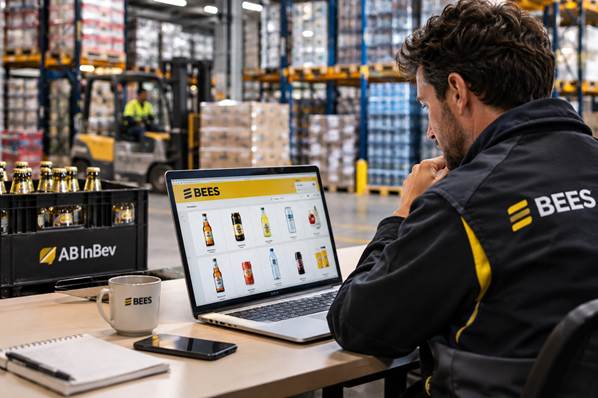
At AB InBev, the change is less visible in the brewhouse or on the label. Decades of consolidation have given the group a worldwide network of customers, distributors and commercial relationships. The infrastructure built to sell its own beer brands as efficiently as possible is acquiring a broader economic function through the digital platform BEES.
Retailers and hospitality operators can place orders through BEES. BEES Marketplace also offers products from other suppliers. In the third quarter of 2026, gross merchandise value for third-party products reached $1.4 billion, up 45% year on year. AB InBev is thus using its established commercial infrastructure increasingly for goods it does not make itself.
The parallels with Amazon, bol and AliExpress are hard to miss. BEES is predominantly a business-to-business platform and works differently from a consumer marketplace, but the similarity lies in the economic value of customer access. A company can earn money not only on its own goods but also by enabling transactions for others.
That brings a second potential advantage, possibly just as valuable: information. A digital trading platform can provide insights into order frequency, product ranges, regional demand and the performance of products from different suppliers. Much of that information previously had to be gathered through paid market research. The platform can therefore become not only a sales channel but also a source of commercial intelligence.
This does not mean AB InBev can use all third-party data without restriction. Actual access and permitted uses are constrained by agreements, data-protection requirements and competition rules. Even within those limits, however, the group may be able to deepen its understanding of the market and identify which products and categories are growing.
For now, the financial returns are harder to pin down. Gross merchandise value is not the same as revenue or profit for AB InBev. Only when the margins earned on these activities and the additional capital required become clearer will it be possible to judge how valuable BEES really is.
Nevertheless, this could prove a more fundamental change than buying another beverage producer. AB InBev is trying to turn its distribution network and commercial information into a platform with economic relevance beyond beer. It may be finding a new use for economies of scale originally created solely to produce and sell beer.
Constellation changes how it buys; Molson Coors must change how it operates
The two American groups demonstrate why diversification is not equally urgent for every brewer. Constellation Brands has sold much of its traditional wine business in recent years and used some of the proceeds to repay debt. This has increased its reliance on Mexican beer brands in the US market, but it has also created more room to deploy capital selectively.
Constellation’s full acquisition of HOPWTR in April 2026 and its purchase of SpikedAde in October show that the group is not abandoning diversification to focus on beer alone. It is still exploring new consumption occasions. More interesting than the products themselves is how the acquisitions are structured. For SpikedAde, Constellation is paying $75 million upfront, with up to $278 million contingent on performance over the following five years.
That structure avoids paying the entire price of an unproven growth forecast upfront. It matters particularly in a market where product categories can become popular rapidly and then settle into more normal growth. Constellation could still overpay, but it is trying to make part of the risk conditional on results actually achieved.
Molson Coors faces a different problem. It is certainly investing in new brands and categories, but the pressure on its traditional beer activities has become so great that individual extensions appear insufficient. Monaco and the Fever-Tree partnership may be commercially attractive, yet they do not automatically alter the cost structure of a brewing organisation built for much larger volumes.
That brings the argument back to the Monaco acquisition that opened this article. The problem is not necessarily that RTDs are the wrong market or that Monaco lacks a promising future. The question is whether Molson Coors can buy or develop enough new profit to offset both declining beer operations and the cost of its industrial infrastructure.
When volumes decline structurally, it becomes increasingly difficult to use existing breweries, filling lines and distribution facilities equally efficiently. New products can help if they use the same infrastructure, but not every RTD can be produced on an existing beer line without further investment. The group must therefore decide not only how to broaden its range, but also how much industrial capacity it will need in the long term.
That makes deeper cooperation, production consolidation or far-reaching restructuring increasingly plausible strategic alternatives. A merger can deliver economies of scale but is no cure-all. If two companies serve the same structurally shrinking market, combining them may reduce costs without generating any additional demand.
The verdict on Molson Coors must go beyond observing that its new brands are not yet contributing enough. The company must demonstrate that it can adapt its existing capital-intensive business model to a structurally smaller beer market. Without that adaptation, further acquisitions risk doing little more than buying time.
The winning measure is return, not range
The seven groups show why diversification cannot be judged simply by revenue growth, new brands or the number of countries in which a company operates. The decisive question is how productively capital already invested is deployed and how much additional return new activities ultimately deliver.
A brewer that also uses its existing filling lines for soft drinks can spread fixed costs across more products. A group that sells a premium brand through a local partner need not own all the production facilities, but must continuously sustain the brand’s value. A digital marketplace can generate more income from existing customers without every new product category requiring its own brewery or production site.
Set against these opportunities are the risks of expensive acquisitions, product fads and excess capacity. A company that buys into a fashionable growth category at its peak may be saddled with an excessive capital burden for years. Meanwhile, a company relying exclusively on traditional beer sales may find itself operating breweries that are being used less and less efficiently.
This does not mean that every group should choose the same path. Kirin has shown that an entirely new business can become a major source of profit. Carlsberg is using Britvic and PepsiCo to broaden the role of its production and distribution network. Heineken combines in-house product development with selective acquisitions and asset-light growth. Asahi is investing in international market positions but must justify the high price agreed for EABL. AB InBev may be able to transform its existing distribution network into a trading and information platform, while Constellation is seeking to allocate its capital more selectively among new growth opportunities.
Molson Coors is in a more difficult position. The group needs not only new revenue but also a convincing answer to the economic consequences of declining volumes. That may require more far-reaching choices than adding another appealing beverage brand.
The international brewing industry therefore faces a more fundamental question than a simple choice between beer and other drinks: which activities deserve a company’s scarce capital, and which fail to earn enough to justify their continued existence?
The future winners need not be the brewers with the broadest brand portfolios. They are more likely to be the companies that make the best use of their know-how, brands, distribution networks and capital-intensive production assets.
For some groups, that will mean developing new lines of business. For others, it will mean partnering, opening existing infrastructure to third parties or divesting activities. And for companies whose beer sales are in structural decline, it may mean dismantling parts of an industrial structure that was successful for many years.
The bill for diversification does not fall due when a deal is announced. It comes due over the years that follow, when promised growth has to become profits and returns on capital.
That is what separates a brewer building its future from one merely paying to keep its past alive.